Can I Still Work With You if I’m on a GLP-1 Medication?
Can I still work with you if I’m taking a GLP-1?
At Maddox Nutrition, this is a question we’re hearing more often from people who are considering nutrition counseling, as well as from current clients.
And the short answer is yes.
Yes. But there’s more nuance to the conversation.
Taking a GLP-1 medication does not automatically mean you can’t work with a non-diet dietitian. It also doesn’t mean your dietitian will automatically tell you to stop taking it.
Instead, an eating disorder-informed, non-diet approach asks a more important question: What is actually happening with your health, nutrition, relationship with food, and relationship with your body while you’re taking the medication?
That context matters.
First, what is a GLP-1 medication?
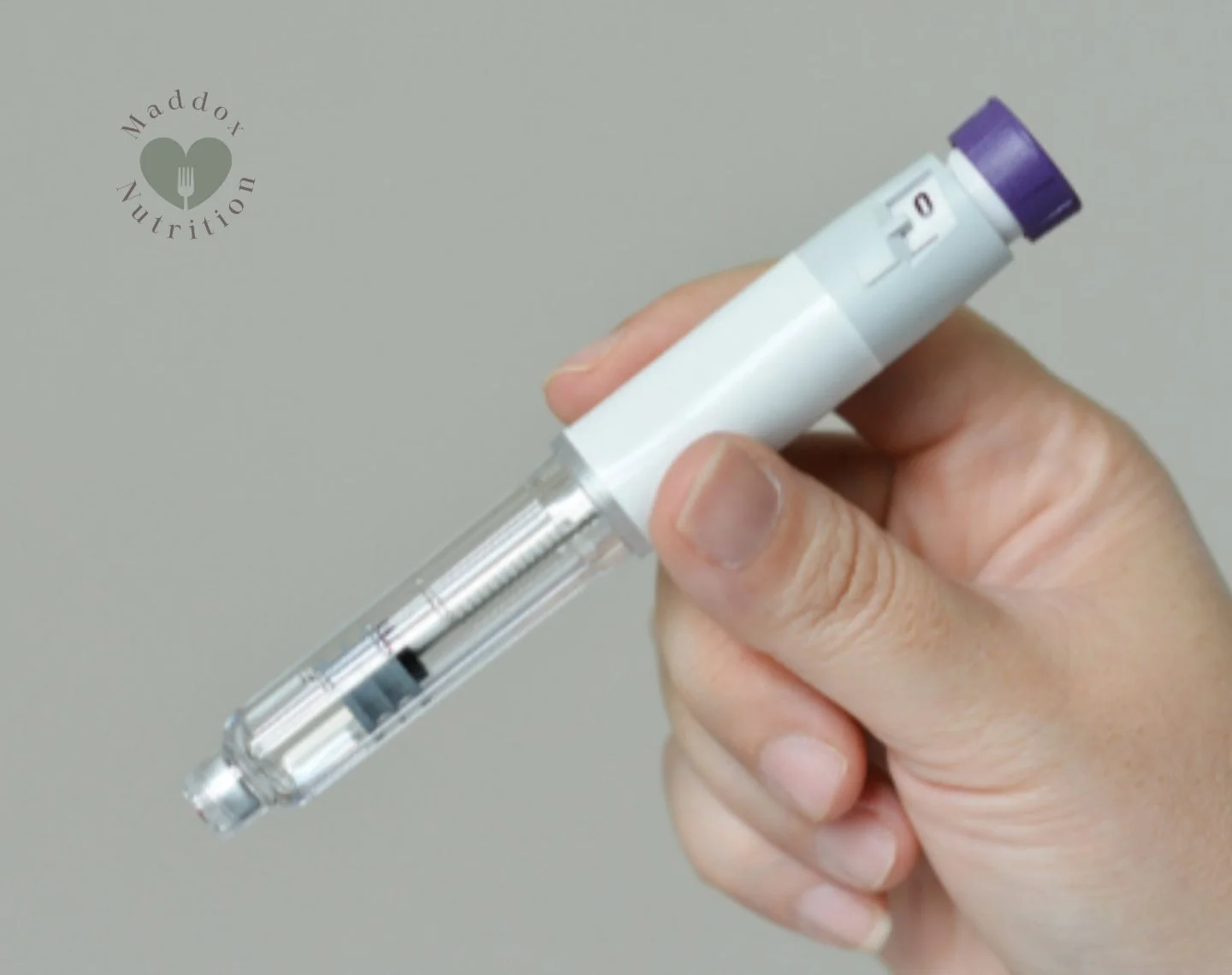
What is a GLP-1 medication? GLP-1 stands for glucagon-like peptide-1, a hormone involved in blood sugar regulation, digestion, appetite, and feelings of fullness.
GLP-1 receptor agonists are medications that mimic some of the effects of this naturally occurring hormone. Depending on the medication, they can help regulate blood glucose, slow gastric emptying, reduce appetite, and increase feelings of fullness.
You may have heard of medications such as Ozempic (semaglutide), Wegovy (semaglutide), Saxenda (liraglutide), or Trulicity (dulaglutide). Tirzepatide medications such as Mounjaro and Zepbound act on both GLP-1 and GIP receptors and are often discussed alongside GLP-1 medications.
These medications are not all prescribed for exactly the same reason.
Some GLP-1 medications are FDA-approved to help manage type 2 diabetes, while certain medications in this broader group are also approved for weight management in people who meet specific medical criteria. Your healthcare provider determines whether a medication is appropriate based on your individual health history and medical needs. It’s important to recognize, however, that weight stigma in healthcare contributes to the over-emphasis of weight loss when non-diet interventions could provide more sustainable, long-term solutions without the risk of weight cycling and harm to relationships with foods.
So when someone says, “Hey, I’m actually on a GLP-1”, there is already an important question to ask: Which type of GLP-1 medication, and why are you taking it?
That question is especially important when you’re working with an eating disorder-informed dietitian.
Three Questions to Consider if You’re Taking (Or Considering) A GLP-1
If you're wondering whether you can work with an eating disorder-informed, non-diet dietitian while taking a GLP-1, it’s recommended to think through these three important areas:
1. Why are you taking the medication?
Start with the context.
Was it prescribed as part of your treatment for type 2 diabetes?
Are you taking it for weight loss?
Are you considering it because you're exhausted from thinking about food?
Are you hoping it will help you feel more in control of your eating or your body?
There’s no right or wrong answer here, and you don’t need to feel ashamed of what brought you to this decision. Your reasons may be complicated, deeply personal, or shaped by years of experiences with food and your body. Understanding that context simply helps your dietitian better understand how to support you.
A dietitian may also want to explore what has happened since you started the medication.
For example:
Are you able to recognize and respond to hunger?
Are you getting enough calories, protein, carbohydrates, fats, fiber, vitamins, and minerals?
Are you experiencing digestive symptoms that make eating difficult?
Has eating become more fear-based?
Are you becoming increasingly disconnected from your body's cues?
These are the kinds of questions an eating disorder-informed dietitian may explore with you.
Our goal as your dietitians isn't to police your food or your medication. It is to understand what is happening and help you meet your nutrition needs while caring for you as a whole person.
2. What is your history with food and your body?
This question can be particularly important if you've experienced an eating disorder, disordered eating, chronic dieting, or significant body image distress.
Your history matters because the same medication can be experienced very differently by different people.
For someone with a history of restrictive eating, for example, a significant reduction in appetite could potentially make it easier to restrict or unintentionally under-eat.
For someone else, their experience may look completely different.
Current research on GLP-1 medications and eating disorders is still developing. A 2024 review noted that there was not enough evidence to determine whether GLP-1 medications improve, worsen, or otherwise affect eating disorder symptoms.
That uncertainty is precisely why individualized assessment matters. Your dietitians may ask questions such as:
What happens emotionally if your appetite comes back?
What happens if you start thinking about food more often?
Does the possibility of weight gain feel frightening?
Is your body size becoming tied to your sense of worth?
Are you becoming less flexible around food or social eating?
Are you able to nourish yourself adequately throughout the day?
And perhaps most importantly: Is the medication quieting food thoughts, or is it suppressing your body's needs?
While those questions can be uncomfortable, they can also be incredibly valuable.
3. Are you afraid your dietitian will tell you to stop taking it?
This may be the question underneath the question.
Sometimes “Can I still work with you if I'm on a GLP-1?” really means: “Are you going to make me stop taking it?”
If that's what you're worried about, it's worth getting curious about that fear.
Are you afraid of gaining weight?
Are you afraid of becoming hungry again?
Are you afraid that you'll lose control around food?
Are you afraid your body will change?
Are you afraid of returning to how things felt before the medication?
And those fears aren't something you need to hide from your dietitian. In fact, they may be exactly what deserves more attention.
At Maddox Nutrition, your dietitian cannot prescribe or discontinue your medication. Medication decisions belong with the appropriate prescribing healthcare provider.
Your dietitian's role is different.
We can help you understand how your nutrition, eating patterns, hunger and fullness cues, digestive health, and relationship with food may be affected. We can also help you identify concerns and communicate with your broader healthcare team when additional medical support is needed.
Depending on your individual situation, your dietitian may also collaborate with your physician or other healthcare providers if there are medical concerns, significant symptoms, or questions that fall outside a dietitian's scope of practice.
What about “microdosing” a GLP-1?
You may have heard people online talking about “microdosing” GLP-1 medications.
Be careful with claims that a smaller-than-standard dose automatically makes a medication safer or more appropriate.
A smaller amount is not automatically a safer amount, and the safety and effectiveness of a particular dosing strategy depend on the medication, indication, and available evidence.
If you're considering changing your GLP-1 medication dose, don't make that decision based on social media or wellness marketing. Talk with your prescribing healthcare provider.
And if you're hearing about compounded or otherwise unapproved versions of GLP-1 medications online, additional caution is warranted. The FDA warns that unapproved versions do not undergo the agency's review for safety, effectiveness, and quality before being marketed.
Your dietitian isn't the food police or the medication police
Again, our goal as your dietitians isn't to control what you eat, what your body looks like, or which medication you take. It's to provide whole-person, individualized nutrition care.
That means your dietitian may ask hard questions.
We may express concern if you're struggling to meet your nutrition needs.
We may encourage you to speak with your physician about concerning side effects.
We may notice that a medication is interacting with eating disorder behaviors or making it harder for you to nourish yourself.
And we may help you explore what you're afraid might happen if you stop taking it.
But those conversations aren't about shame or control. They're about care.
So, can I still work with you if I’m on a GLP-1?
YES! We want to support you even more because of the complexities these medications bring to food and nutrition. At Maddox Nutrition, being on a GLP-1 medication isn't an automatic reason to turn you away. Instead, we want to understand the full picture.
Why are you taking it?
How is it affecting your appetite and eating patterns?
Are you able to meet your nutrition needs?
What is your history with dieting, food, and your body?
Do you have an eating disorder or history of disordered eating?
What fears come up when you think about stopping the medication?
And perhaps the biggest question: Is this helping you build a more nourished, sustainable, and peaceful relationship with food or is it making that relationship harder?
Sometimes GLP-1 medications may simply be one part of someone's broader healthcare. Sometimes they can complicate eating disorder recovery or make adequate nourishment more difficult.
And sometimes, simply talking about GLP-1s can uncover deeper fears about hunger, weight gain, body changes, or control, that deserve attention.
You shouldn't have to hide those conversations from your healthcare providers. You deserve care where you can be honest.
Moreover, as adults, you have autonomy and agency when making decisions about your healthcare. Dietitians don't prescribe medications or have the authority to make those decisions for you. Our role is to provide nutrition expertise, education, recommendations, and support while collaborating with the rest of your healthcare team when appropriate.
Visit Maddox Nutrition at maddoxnutrition.co to learn more about our eating disorder and non-diet nutrition counseling services and explore whether working with a registered dietitian nutritionist could be a helpful next step for you whether you are or not on GLP-1.
Want to Hear More About GLP-1s and Nutrition?
If you want to explore this topic in more depth, we also discussed GLP-1 medications, eating disorder recovery, nutrition, and the non-diet approach on an episode of the Maddox Nutrition podcast.
Listen to the full episode: Can I Still Work With You If I’m on a GLP-1?
–
What you need to know
The difference between a Dietitian and Nutritionist
A dietitian is a regulated healthcare professional who has completed formal education in nutrition and dietetics, undergone supervised training, and is licensed to provide medical nutrition therapy for conditions such as diabetes, eating disorders, or gastrointestinal issues.
The title “dietitian” is legally protected in many countries, ensuring that only those who meet strict professional standards can use it.
In contrast, the title “nutritionist” is not always regulated, meaning anyone can call themselves a nutritionist regardless of training, though some may hold advanced degrees or certifications. Generally, dietitians are qualified to offer clinical nutrition care, while nutritionists often focus on general wellness and healthy lifestyle guidance.
-
Looking for more?
Our team has put together a list of the books, journals, and everyday tools we find ourselves recommending again and again. Head over to our Recommendations page to take a look. Just so it's clear: these are general suggestions, not personalized advice, and there's no expectation to purchase anything. Whether you're a current client, working with another provider, or just here reading, these are simply resources we've found genuinely helpful.
The links you’ll find in the Recommendations page are Amazon affiliate links. If you click one and buy something, we might earn a small commission — it won't cost you extra, and it's entirely your call whether to buy anything at all. These are just things our team likes, not a promise that any of them will work a certain way for you, and not personalized advice.